Smita Deogaonkar-Baride , Mitesh Koli , Sirisha Majji , Asavari Dhawale , P. Saroj and , Santosh Ghuge
This work explores the e-beam treatment method for treating wastewater that contains reactive dyes, Reactive Red 198 (RR 198) and Reactive T. Blue 21 (RB 21) in combination with salts. The effects of e-beam treatment were compared and analyzed for changes in pH, chemical and biological oxygen demands (COD and BOD), colour and toxicity for particular reactive dye solutions and reactive dye effluent. Biodegradability enhancement with e-beam treatment was assessed in terms of the increased ratio of BOD/COD.
Shreyash Mohite, M. Amarnath, Shital Palaskar
The escalating demand for sustainable and flexible energy storage systems in wearable technology has driven research into advanced electrode materials. This mini-review explores the synergistic potential of metal-organic frameworks (MOFs) and conductive polymers (CPs) as hybrid electrode materials for next-generation smart textiles. While conducting polymers like polyaniline (PANI) and polypyrrole (PPy) offer high conductivity and flexibility, they suffer from mechanical fatigue and instability during cycling. Conversely, MOFs provide ultrahigh surface area and tunable porosity but are limited by poor intrinsic electrical conductivity.
Shreyasi Nandy, T V Sreekumar , Abhishek P M , Shubham Shinde , Neha Mehra
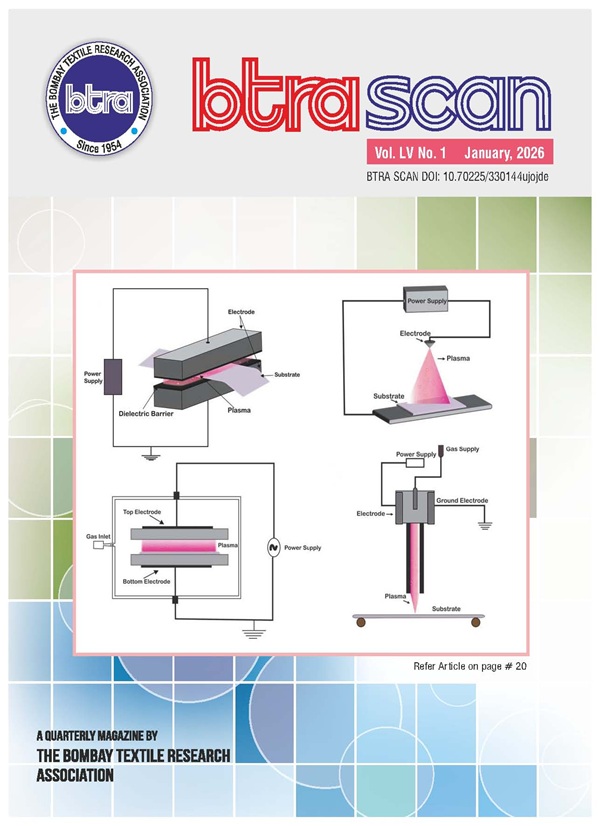
Flame-retardant materials are increasingly critical across textiles, polymers, electronics, and construction, yet conventional chemical finishing often compromises fabric integrity, durability, and environmental safety. Plasma-assisted surface modification has emerged as a sustainable alternative, selectively functionalizing the outer nanolayers of substrates without altering bulk properties. This review highlights the principles and types of plasma, particularly non-thermal methods such as dielectric barrier discharge (DBD), corona, and glow discharge,

© BTRA 2026 All Rights Reserved