The Bombay Textile
Research Association

Search
Close this search box.

The Bomby Textile
Research Association

Call Us

Email Us

Search
Close this search box.

BTRA Scan Articles -October 2026

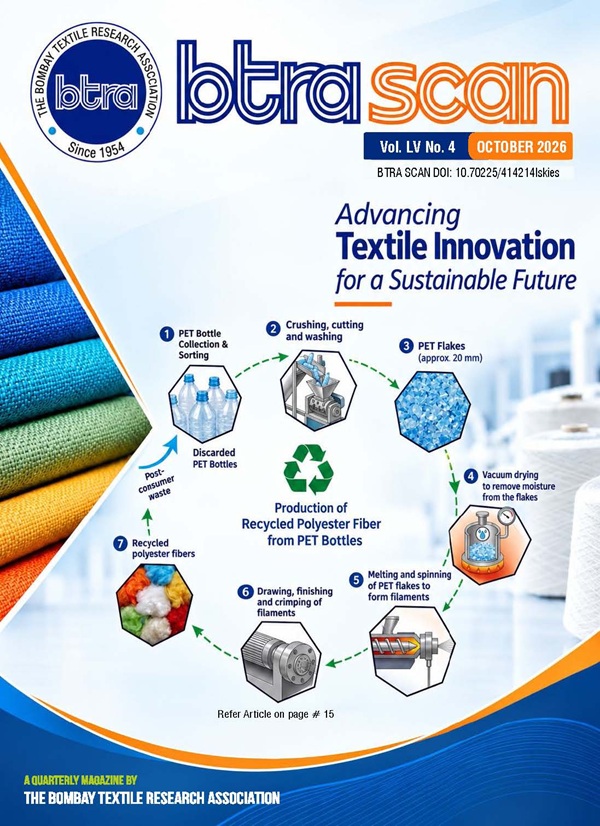
Comparative Analytical Characterization and Chromatographic Profiling of Virgin and Recycled Polyethylene Terephthalate (PET)

Tanvi Patil, Shraddha Nitturkar, Geetanjali Mishra & Karishma Hemani

Polyethylene terephthalate (PET) and its copolymeric variants represent a critical class of thermoplastic polymers widely deployed in packaging, industrial textiles, and consumer products due to their tensile strength, dimensional stability, and chemical resistance. PET materials are broadly categorized into virgin polyester (vPET), derived directly from petrochemical feedstocks, and recycled polyester (rPET), produced via the mechanical or chemical reprocessing of postconsumer polymer waste. While functional performance across both forms remains comparable, structural differences in chain morphology, thermal degradation history, and comonomer distribution persist.

Developments of standard procedure to identify dope dyed and exhaust dyed meta aramid yarn

Komal Kukreja, Prasanta K. Panda
Indian Air force uses meta-aramid overall for their pilots due to its excellent properties such as high strength, flame and chemical resistance, etc. Dyeing of those overall materials is recommended through a dope dyeing process to achieve good fastness properties and uniformcolor. Dope dyeing is the process of adding color during spinning, while in the exhaust dyeing process, dye is gradually transferred from dye bath to textile materials. However, the fabric of the same color with different preparation routes looks similar but behaves differently during actual application due to different fastness properties. No standard method distinguishes exhaust or dope-dyed meta-aramid fiber/fabric.

Transitioning to Green Textile Manufacturing: The Synergistic Role of Microbial Enzymes and Biosurfactants

Neelam Ware
The textile industry is under severe pressure to replace highly polluting chemical processes with eco-friendly alternatives. While individual applications of microbial enzymes (e.g., cellulases, amylases, pectinases, laccases) and microbially derived biosurfactants (e.g., rhamnolipids, sophorolipids, surfactin) have advanced sustainable textile processing, their combined, synergistic application represents an unmapped frontier. This review comprehensively analyzes the multi-faceted mechanisms driving the synergistic relationship between microbial enzymes and biosurfactants across wet processing operations including desizing, scouring, bleaching, biopolishing, and wastewater remediation.

Upload Resume